
The financial sector is one of the most dynamic and competitive industries in the world. From banking and investment management to fintech and financial consulting, professionals in this field are expected to combine technical expertise with strong interpersonal and analytical abilities. As the industry evolves through technology, regulation, and global economic change, the skills required for success are also expanding.
For individuals considering a career in finance, developing the right mix of competencies can significantly improve both employability and long-term career prospects.
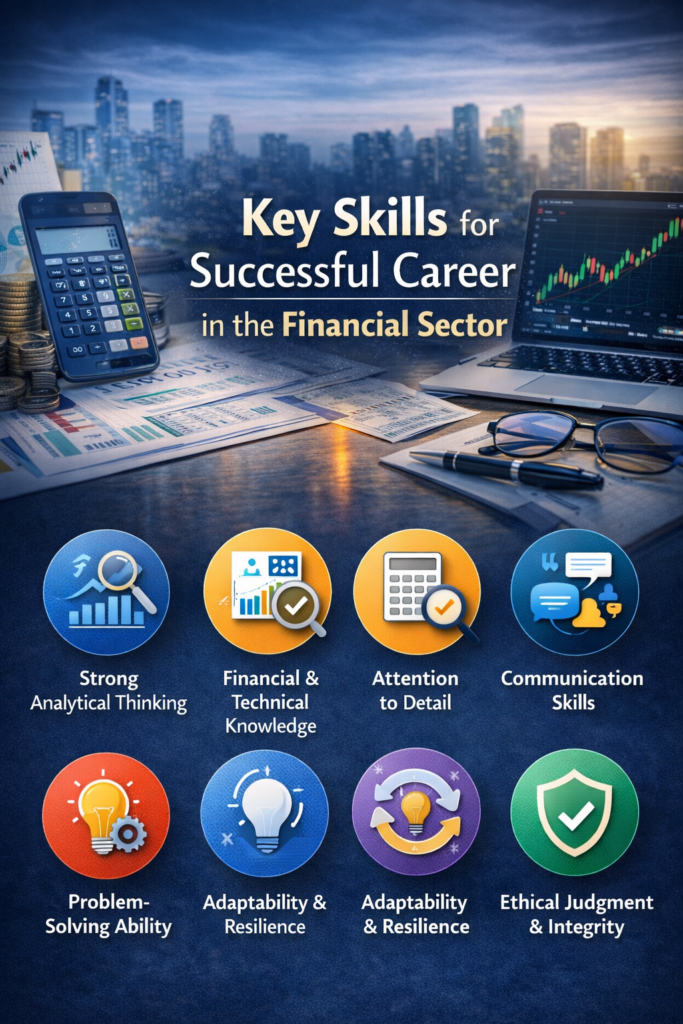
Strong Analytical Thinking
At the heart of finance lies the ability to analyse information and make sound decisions based on data. Financial professionals constantly interpret numbers, evaluate risks, and assess opportunities.
Whether reviewing investment portfolios, forecasting financial performance, or analysing market trends, analytical thinking enables professionals to transform complex data into meaningful insights. This skill is essential across roles such as financial analysts, portfolio managers, risk specialists, and corporate finance professionals.
Financial and Technical Knowledge
A solid understanding of financial principles is fundamental. This includes knowledge of accounting, financial modelling, valuation methods, and economic concepts.
As financial services become increasingly technology-driven, professionals are also expected to understand digital tools and financial systems. Familiarity with data analytics, financial software, and emerging technologies such as fintech platforms can provide a strong advantage in the job market.
Continuous learning is particularly important in finance, as regulations, markets, and technologies evolve rapidly.
Attention to Detail
Precision is critical in the financial sector. Small errors in calculations, reports, or compliance documentation can have significant consequences.
Professionals must therefore demonstrate a high level of accuracy when handling financial data, preparing reports, or reviewing transactions. Attention to detail helps ensure reliability, maintain compliance with regulations, and protect the integrity of financial operations.
Communication Skills
Finance is not only about numbers; it is also about explaining complex information clearly. Professionals often need to present financial insights to clients, colleagues, or senior management who may not have technical backgrounds.
Strong communication skills enable individuals to translate complex financial concepts into clear and understandable messages. This is particularly important in roles involving client relationships, advisory services, or strategic decision-making.
Effective communication also supports collaboration across teams and departments.
Problem-Solving Ability
Financial professionals frequently face challenging situations, from managing investment risks to responding to changing market conditions.
The ability to approach problems logically and develop practical solutions is therefore highly valued. Problem-solving skills allow professionals to evaluate alternatives, anticipate potential outcomes, and make informed decisions under pressure.
Adaptability and Resilience
The financial industry is constantly evolving. Economic shifts, regulatory updates, and technological innovation require professionals to adapt quickly.
Successful individuals in finance remain resilient in the face of uncertainty and are comfortable working in fast-paced environments. They are willing to learn new tools, update their knowledge, and embrace change.
Adaptability is particularly important as digital transformation continues to reshape the financial services landscape.
Ethical Judgment and Integrity
Trust is the foundation of the financial sector. Clients, institutions, and regulators rely on professionals to act responsibly and ethically.
Strong ethical judgment ensures that financial professionals operate with transparency, maintain compliance with regulations, and prioritise the interests of clients and stakeholders. Integrity is therefore one of the most valued qualities in the industry.
Conclusion
A successful career in the financial sector requires more than technical knowledge alone. Professionals must combine analytical ability, communication skills, attention to detail, and strong ethical standards while remaining adaptable in a rapidly changing environment.
For those willing to continuously develop these skills, the financial sector offers a wide range of rewarding career opportunities and the chance to make a meaningful impact within global markets and organisations.